




Just when you think you’ve figured out which social platform to prioritize, you see another brand performing exceptionally well on a different channel—and you start wondering whether you should be there too.
That pressure is real. Choice is a wonderful thing, especially as a retailer attempting to reach your target customers. But too much choice can become overwhelming and confusing (decision fatigue, anyone?). The trick is deciding which channels make the most sense for your brand and then doubling down on one or two of them. (For most small teams, it’s usually more effective to focus on one primary channel and add a second only when you can maintain quality and consistency.)
So, let’s discuss YouTube. As one of the first social platforms to emerge (it was founded in 2005), YouTube isn’t just for watching music videos or highlights of your favorite TV show. Here’s a fun fact about YouTube: YouTube is one of the world’s largest search platforms and the #2 most-visited website after Google.
Google acquired YouTube back in 2006, giving it powerful search and keyword capabilities. Once you wrap your head around that, the sky’s the limit when it comes to what you can do with the video-based network—especially now that short-form video (like YouTube Shorts) and long-form content can work together in the same channel strategy.
For starters, YouTube is a great way to build brand awareness and get your target customer to feel connected to your products or services. And with standout content, you have a higher chance of your videos going viral.
Key Takeaways
- Use YouTube for both discovery (search + recommendations) and trust-building (longer demos, tutorials, and reviews).
- Plan content around retention: make the video as short as possible while still delivering the value.
- Repurpose strategically: cut YouTube videos into Shorts/Reels/Stories to reach new audiences.
- Optimize for findability: strong titles, descriptions, and accurate tags (metadata) help YouTube understand your video.
True: You can create standout videos with your iPhone video camera.
False: It’s simply a matter of posting your video ad campaign on your branded YouTube channel and hoping for the best.
Let’s take a look at how you can create a successful YouTube strategy and get inspired by three retail brands making a strong impression on YouTube.
Why YouTube?
Is YouTube right for your brand? For starters, assess where your customers hang out online. Here are a few current, high-level stats about the platform:
- YouTube is the #2 most-visited website globally, which makes it a major discovery channel for products and brands.
- Over 500 hours of video are uploaded to YouTube every minute, so consistency and clear positioning matter.
- YouTube supports both short-form and long-form video, letting you mix quick discovery content (Shorts) with deeper product education (tutorials, comparisons, and reviews).
As for the industries that lend themselves best to YouTube? No surprises here: Beauty, food/cooking, fashion, wellness, fitness, sports, and gaming — to name a few.
We spoke with Andrea Corson, digital video strategist, consultant and producer who helps business owners grow their brands using video, with her company, Video Pop.
Corson’s first important point when it comes to industries that work best on YouTube.
If approached correctly, pretty much any industry can massively benefit from YouTube. It all lies in the storytelling and showing your customers/audience how you're helping to solve their problems.
And when it comes to content and storytelling, the objective of your YouTube videos should always be one of these three things:
- Inspiring
- Educational
- Entertaining
Corson gave us the step-by-step rundown of YouTube tips for creating stellar content, to help you make an impact, increase your traffic, and ultimately increase sales.
7 Tips To Create Strong YouTube Content
Intrigued? Leveraging the power of YouTube and its capabilities is an opportunity that you as a retailer can hone in on too. Consider the following tips to be your cheat-sheet to YouTube success.
1. Be consistent
Posting a video at least once a week is crucial when it comes to YouTube success. This means consistency in terms of cadence and posting time. Post at the exact same time every week and put this schedule directly in your channel banner artwork (i.e. the photo at the very top of your channel) so that people know when to expect your content. If you post Tuesdays at 7pm, your subscribers should know that. So yes, this means you need to commit to rolling out new content on the regular.
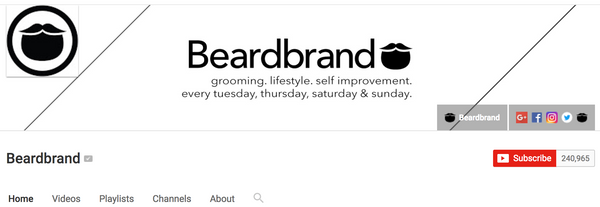
One example of this is Beardbrand, which clearly states in its YouTube banner that viewers can expect new videos on Tuesdays, Thursdays, Saturdays, and Sundays:
“The ideal day or time? There’s no right or wrong, as long as you are consistent!” Corson explains. “The YouTube community, more so than any other community, demands frequency and consistency. I've seen more than a few creators/brands with large followings lose a significant percentage of their subscribers the moment their consistency or frequency takes a hit.”
2. Invest in Sound, Lighting, and Editing
Wondering where to invest your money? Here you go, in order of priority:
A: Killer sound: If your viewers can't hear you clearly, they won’t make it past the first 30 seconds of your video. And all of that work will be for nothing.
B: Fantastic lighting: Great lighting makes the difference between homemade and truly spectacular. But not to worry — you don’t need to break the bank to achieve great sound and lighting. Corson clarifies: “Budget-friendly yet totally proficient sound and lighting equipment will cost you about $400 to $500, but keep in mind that this equipment will last quite a while, typically about 3 to 5 years.”
C: Top-notch editing software: A subscription to Adobe Premiere is always Corson’s third recommendation. “It’s the most user-friendly editing software to get you up and running, and comfortable quickly — and I've used every editing software under the sun ALL during my time in television — but Premiere also has all of the necessary bells and whistles that can take your video up to commercial grade.”
3. Stick to the Ideal Length
There isn’t one “sweet spot” for YouTube video length. Aim for the shortest length that delivers the value, then use YouTube Analytics (especially Audience Retention and watch time) to see where viewers drop off and tighten future videos accordingly.
Many viewers won’t make it to the end if the hook is slow—so open with the outcome, show what they’ll learn or get, and get into the steps quickly.
People's attention spans are unbelievably short these days — so you have to hook their interest and keep them along for the ride. What story would you want to hear? What would pique your interest? It's important to put yourself in your viewers’ shoes. If you wouldn't want to watch your video, then surely no one else will either.
4. Don't Bite Off More Than You Can Chew
Stock up on at least three to four videos before your launch, so in the case of a content or marketing emergency, you have a backup or “stash,” and make sure you stick to your video publishing calendar. And if it makes you feel better, remember that you don't need to reinvent the wheel.
Corson elaborates:
Start with a simple concept that makes for a great story, but doesn't have you managing 10,000 variables. Stick to one location. Focus on demonstrating your value. Simple and clever often performs best anyway.
5. Keep YouTube SEO in Mind
As mentioned, YouTube is one of the world’s largest search platforms, even though most of us don't think of it that way. Searchability is important: Your customers need to be able to find you. After all, you’re solving their problems. As a result, optimize your title's keywords and make sure you use all the tags you can (YouTube tags are metadata you add to a video to help categorize it; they’re not the same as HTML meta tags on a webpage).
Corson shares this tip: “My favorite tool for this is TubeBuddy (a YouTube channel management toolkit). It's incredible what a difference these details make in your channel's performance. Don't go to the trouble of taking on YouTube if you're going to drop the ball where it counts: keywords.”
6. Repurpose the Content You’re Putting on YouTube
Get that return on your investment. You've already gone to the trouble of putting this video together, so you should be using it in as many ways as possible. The reality is that your YouTube subscribers are YouTube people, your Instagram subscribers are people who love Instagram, and so forth. Everyone has a favorite social platform, and they typically find and connect with you on one, two tops. So, reach as many people as you can with each video.
That said, your YouTube videos can be cut into short trailers for your other social platforms (for example, 15–60 seconds for Stories, and short clips for Reels/Shorts). Since your YouTube videos should be part of your overall marketing strategy, they should complement your efforts elsewhere, such as on your other social channels and your website.
Instagram supports longer video now—for example, Reels can be up to 3 minutes (as of January 2025), and Stories allow up to 60 seconds per clip.
Sadly, I've seen brands and businesses launch channels that are too far from their typical branding and they never do well," Corson says. "People want to put you in a box. They want to know what they're coming to you for. If you're an enigma, they simply stop trying to figure you out. And that means no more visits to your channel.
7. Have a Plan for Your Channel
YouTube success is never by accident or happenstance. Channels are constructed with purpose and direction, even if you are simply using an iPhone camera to shoot the videos.
Since there is a lot of strategy and planning that goes into launching a successful YouTube channel, seek out the help of an expert to make sure you have all of your i's dotted and t's crossed. You want to set yourself up for success! Andrea Corson, for example, holds an 8-week masterclass called YouTube Academy, which walks people through creating and launching a successful YouTube channel.
Best In Class: 4 Brands With Standout YouTube Content
LuxyHair
Why they’re nailing it: Tutorials reign supreme on YouTube, which lend themselves well to beauty and hair brands.
With step-by-step instructions on curling and styling hair, there’s clearly an audience for this type of content. Yes, parts of these tutorials can be posted as Instagram videos, but YouTube is still a rich platform to serve up longer educational content, product comparisons, and full routines.
BeardBrand
Why they’re nailing it: The premium men’s grooming company offers up YouTube content with four new videos per week (they specify their posting days right there on the banner image at the top of their channel) — talk about frequency!
BeardBrand’s YouTube channel focuses on grooming and lifestyle; their content is in line with their core values (freedom, hunger, and trust). With self-improvement and beard/hair/body grooming tips, as well as style-related content, they have become the brand equivalent of GQ and Esquire on YouTube.
Reshoevn8r
Why they’re nailing it: For starters, they know their audience and as a result, their content is focused: they offer sneaker cleaning tutorials on a weekly basis. No fancy footwork here; this “Ultimate Sneaker Cleaner” brand showcases step-by-step tutorials on restoring sneakers using their shoe care kits, set to a guy-centric score or soundtrack. Bonus points for strong editing skills!
It’s interesting to note that Reshoevn8r offers a promo code in the video description and mentions it during the video; this is a great way to direct viewers to your website with a direct call-to-action.
Hit Record
Here’s hoping you feel inspired to consider YouTube as part of your marketing strategy. There’s a huge opportunity for brands thinking of venturing into video territory; just remember to press “pause” before diving right in. Consider your target audience, what kind of content you can produce consistently, and the tips for YouTube success—then build a simple publishing plan you can stick to for the next 8–12 weeks.
If you want more channel-building ideas, explore Shopify’s YouTube marketing guide for retailers and map your next video to a specific customer question (setup, sizing, ingredients/materials, before-and-after, or troubleshooting).
Read more
- 5 Lessons Traditional Retailers Can Learn From DTC Brands
- 4 On-Site Optimization Tips for Local SEO to Help You Rank Higher
- What Retailers Need to Know About Voice Shopping
- 24 Retail Blogs Every Small Business Entrepreneur Should Be Reading
- 7 Examples of Retailers Collaborating to Reach Broader Audiences
- What Retailers Can Learn From The Museum Of Ice Cream’s Sweet Success
- Affiliate Programs for Retailers: What Are They and How They Can Boost Your Revenue
- How to Create Retail Packaging That Drives Sales [With Examples
YouTube Marketing for Retail Businesses FAQ
What is YouTube marketing for retail businesses?
YouTube marketing for retail businesses means using a branded channel and standout videos to build brand awareness, connect customers to products or services, and drive traffic and sales. Videos should aim to be inspiring, educational, or entertaining, with a clear plan rather than posting and hoping.
How often should retailers post YouTube videos for growth?
Post at least once a week, and keep the cadence and posting time consistent. Publish at the exact same time every week and put the schedule in the channel banner so subscribers know what to expect. There’s no perfect day or time—consistency matters.
How do I optimize YouTube videos for search results?
Use YouTube SEO by optimizing the title’s keywords and using all the tags available, since searchability helps customers find solutions. YouTube is the second-largest search engine, so keywords matter. A channel management toolkit can help identify and apply the right keyword details.
Why is YouTube a good platform for brand awareness?
YouTube can build brand awareness by helping target customers feel connected to products or services, and standout content has a higher chance of going viral. It also reaches 81.2% of internet users in the U.S. and attracts an even split of women and men.
Can I create high-quality YouTube videos using my phone?
Yes—standout videos can be created with a phone camera, but quality depends on planning and production basics. Prioritize clear sound first, then lighting, then editing. Budget-friendly sound and lighting equipment costs about $400 to $500 and typically lasts about 3 to 5 years.


